


It is well known that Luftwaffe’s Arado 234s were hasty launched to fight around Berlin during the last days of April 1945 to support the Wehrmacht final effort against Soviet armour advancing through the capital doorsteps. But did you know that the Ar234 jet-bombers operated and dropped bombs over Berlin itself?
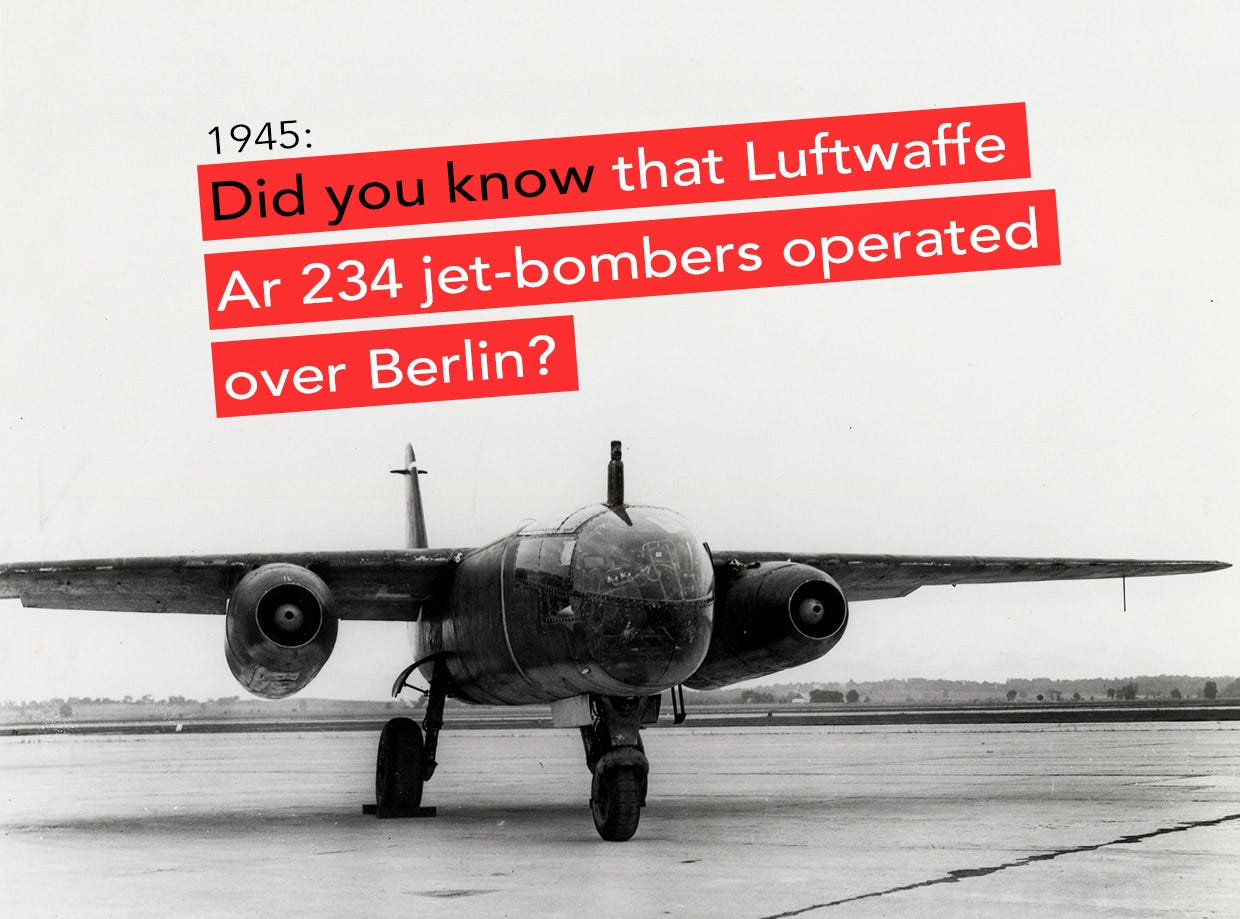
From April 20th through to the beginning of May 1945, the operational emphasis for KG 76 was directed to the East, where it supported the defensive battles around Berlin and Zossen, but less known and a good revelation reading the excellent Arado Ar 234 Bomber and Reconnaissance Units Osprey book by Robert Forsyth (2020) is that the jet-bomber was used directly on Berlin’s grounds too.
Despite adverse conditions and heavy losses —the unit’s airbases and facilities had been heavily bombed the previous month by US Eight Air Forces raids, destroying several Arados on the ground— Kampfgeschwader 76’s squadrons, equipped from mid-1944 with the world’s first and revolutionary jet-bomber (designed by Arado), were ordered to attack Soviet tanks and armoured columns on their way to Zossen and southern Berlin.
Retreating from the Rhine bases due to Allied advance, Arado units (II and III./KG76) moved to Lübeck-Blankesee and Alt‑Lönnewitz meanwhile flew daily sorties harassing British and American motor columns, with their first eastern operation being on April 6th, with sorties made against the Soviet 1st Ukrainian Front to the south of Berlin. Continual threat or presence of Allied fighters over the Arado bases made their take‑offs and operations very dangerous so most missions were launched at dusk.
During the evening of the 20th, Arados attacked Soviet columns on a road leading from Zossen to Baruth/Mark. 6./KG 76 aircraft attacked Soviet advance in the northern area too on April 24th, bombing motor columns advancing to Oranienburg in their way to encircle the capital, and pontoon bridges at the Havel were bombed that evening too (Feldwebel Wördemann).
‘Continuous attacks’ were ordered by the OKW two days later operating against the Soviet tanks, now entering the capital outer districts. As Forsyth (2020) shows: ‘On the 26th, having received orders to carry out ‘continuous attacks’ on districts of the German capital, aircraft from 6. Staffel operated against Russian armour. OFw Breme was instructed to bomb tanks reported to be in the Tempelhof area. ‘The area of Tempelhof–Neukölln–Hermannplatz is already occupied by the Russians – here you see no fires’, he later recalled. ‘North of the Hermannplatz, 300 m‑high flames blaze in a blue sky. The Hallesches Tor is a complete sea of flames. I did not want to drop a bomb there, so I released it blind over a lake east‑south‑east of Schwerin.’ Three days later, Breme was back over Berlin, where he carried out an attack on columns of enemy tanks to the east of the city, while Stabsfeldwebel Karl Ballermann dropped an SD 500 in a glide attack on a specific spot in the capital’s ‘government district’ in the afternoon.’ Another source says that III/KG 76 made sorties on April 29th on Saarlandstraße and Belle-Alliance-Platz in Berlin’s city-centre.
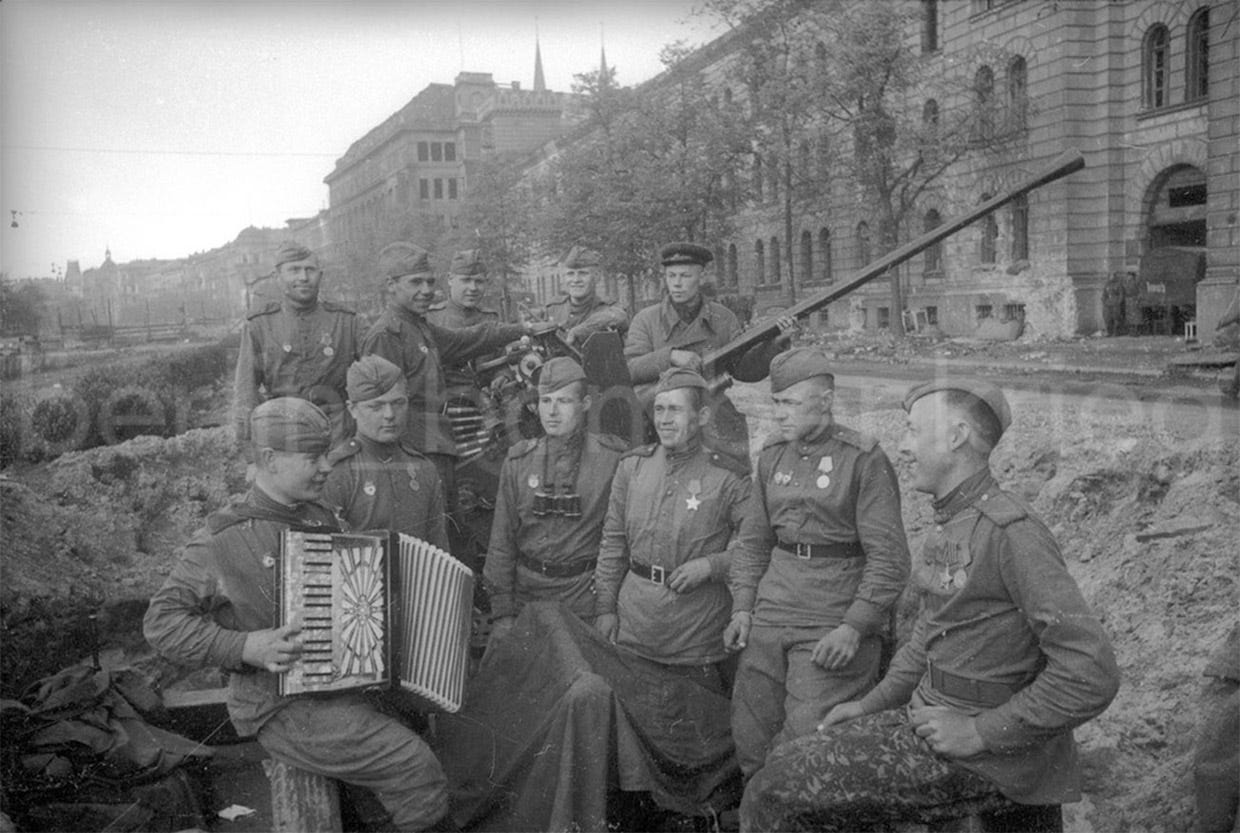
Final ‘Battle of Berlin’ mission came on May 3rd when eight Arados from the Einsatzgruppe took off from Lübeck‑Blankensee to attack Soviet tanks around the capital. Then, the bulk of the Geschwader’s surviving Ar 234s were ordered to fly to Leck, close to the Danish border and to Norway (other aircraft flew to Czech Pilsen area), where they surrendered to Allied advancing troops on May 7th.
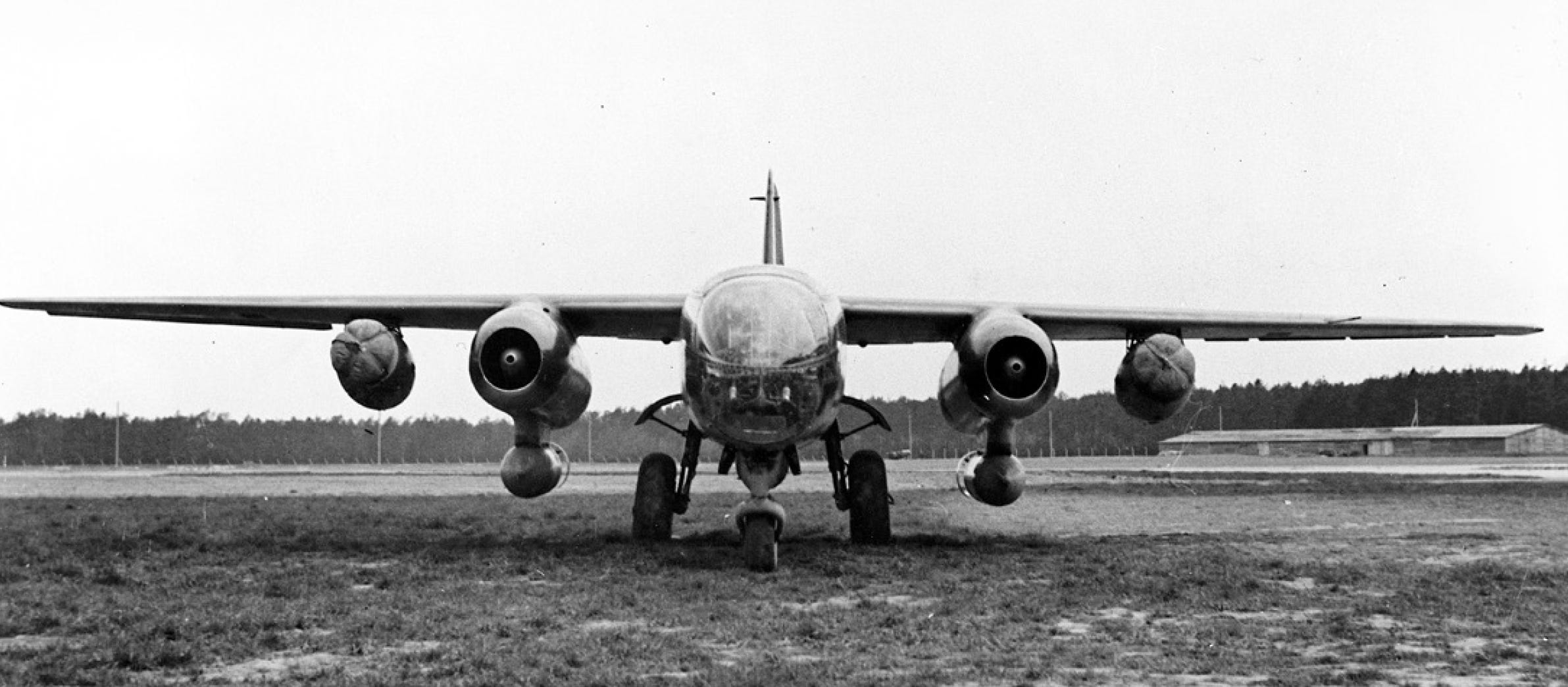
Some other Arado 234 variants, in this case a special one, were also deployed in action over Berlin: the Ar 234B-2/N Nachtigall (Nightingale) was an interim night-fighting variant of the jet-bomber equipped with a FuG 218 Neptun interception radar and a lower fuselage gondola containing two MG 151/20 20mm guns. During February and March 1945, it seems that three of these Arado fighters were operated from Oranienburg by special unit Kommando Bonow, named after its leader, Kurt Bonow, and flew several trial combat sorties on Mosquito-hunting role (the RAF’s nuisance bombers which harassed the city every night) over the German capital, but without achieving any success. Known trials are based on pilot’s logbooks and log records and their operations are unclear.
‘The Blitz jet-bomber’
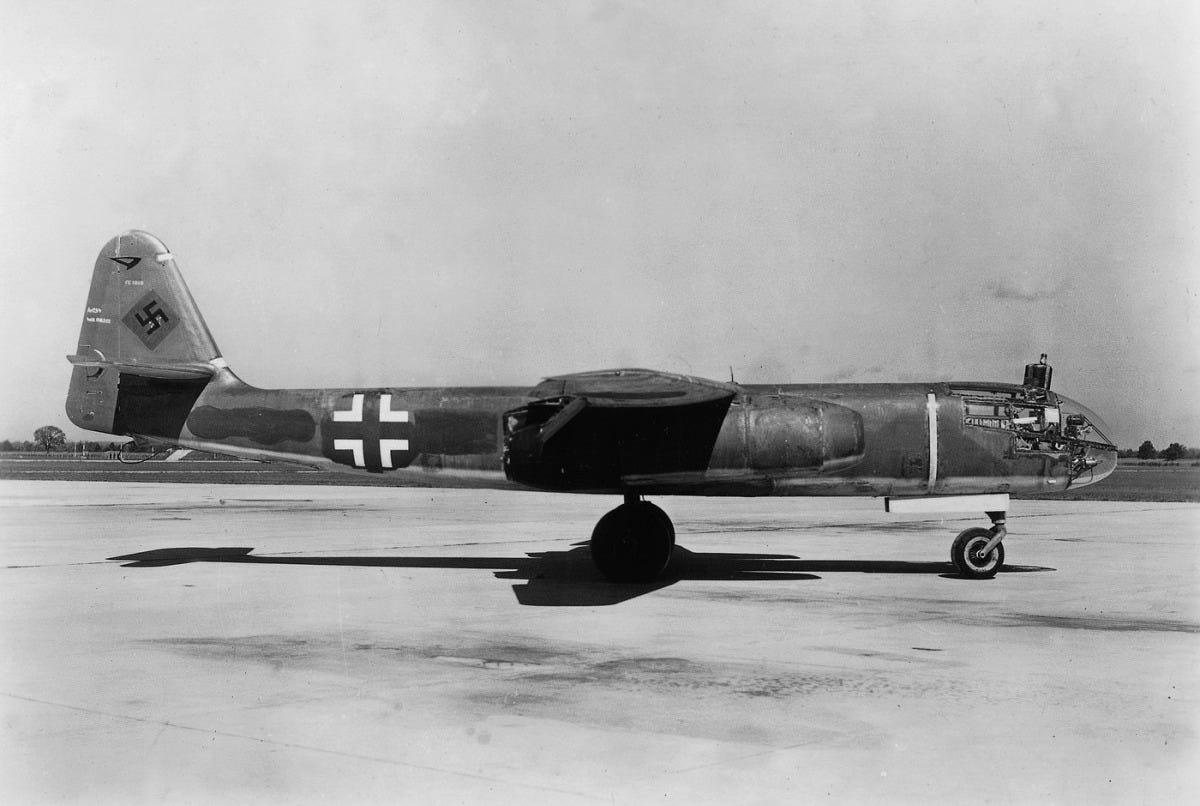
The revolutionary single-seat Arado Ar 234 “Lighting” bomber was powered by two Jumo 004 turbojets (same as the Me 262), performing (in theory) a maximum speed of 461 mph (742 km/h) at 19,685ft (6,000m) and was able to carry three 500-kg bombs or even a 1,400 kg bomb on the centreline in close-range sorties, this could be SD or SD HE bombs or the AB fragmentation bomb dispensers also. In late December 1944 the Luftwaffe surprised the Western Allies when it unexpectedly introduced this new, high-speed bomber to its inventory. The Germans built 210 units from mid-1944 to the end of the war. Improved and powered up version Ar234C with four engines and revised design arrived too late to enter combat.
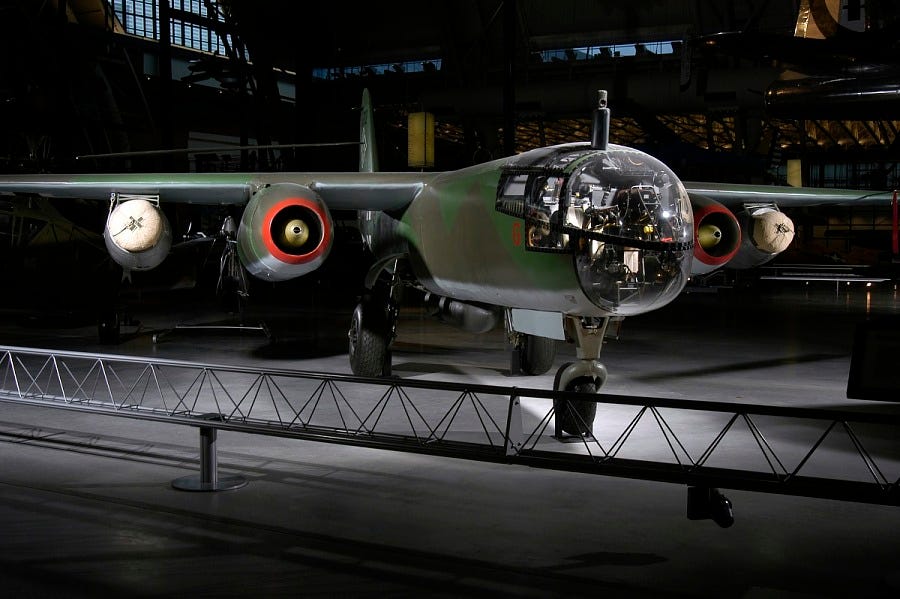
Today, only one Ar 234B example survives. It is displayed at the Steven F. Udvar-Hazy Centre part of the Smithsonian National Air and Space Museum in Washington. This Arado (Werk Nummer 140312), operated during the final months of the war by 8. Staffel III/KG 76 was captured intact by the British at Sola Airfield near Stavanger, Norway, and later sent to the US as war trophy and test aircraft.
_______________
Bibliography and sources:
Antill, Peter. Berlin 1945: End of the Thousand Year Reich. Osprey Publishing, 2005
Beale, Nick. Kampfflieger 4: Bombers of the Luftwaffe: Summer 1943-May 1945: v. 4 (Kampfflieger: Bombers of the Luftwaffe). Classic Publications, 2005
Creek, Eddie & Forsyth, Robert. Blitz Bombers: Kampfgeschwader 76 and the Arado Ar 234. Chandos Publications Ltd
Forsyth, Robert. Arado Ar 234 Bomber and Reconnaissance Units: 134 (Combat Aircraft). Osprey Publishing, 2020
Lowe, Malcolm V. Flypast Classics: ARADO Ar 234. KeyAero. 29th October 2020 [accessed April 2026.]
Murawski, Marek J. Arado Ar 234 Blitz. Kagero, 2007
Price, Alfred. The Last Year of the Luftwaffe: May 1944-May 1945. Weidenfeld Military, 1993
Zapf, Andreas. The Jet Night Fighters: Kurt Welter & the Story of the Messerschmitt Me 262 Night Fighters. Independently published, 2019
Thank you for reading Berlin Bombenkrieg by Pablo López Ruiz. Please subscribe, if you haven’t yet, to comment, follow and share. All images used for non profit / educational purposes.