


Actually, the first bombing raid over Berlin was a French affair.
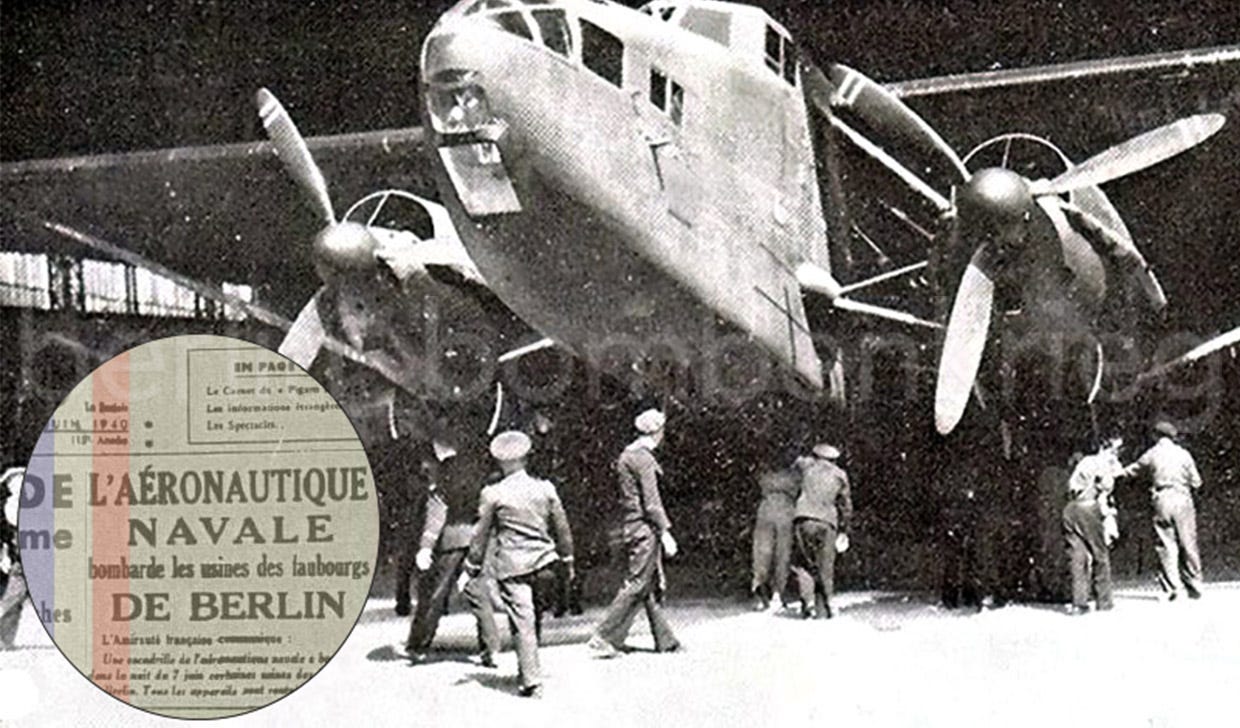
On Monday, June 3, 1940, the Germans launched “Operation Paula” with a Luftwaffe force of some three hundred bombers attacking aircraft factories around Paris and causing several hundred civilian casualties.1 The French decided to retaliate, and although they didn’t have a comparable number of bombers, a psychological blow to the enemy was deemed necessary. American journalist William L. Shirer, who was at the time of the raid based at Berlin working in the CBS radio network, wrote in his diary on June 5th: ‘… BBC says the Parisians are demanding revenge. But no planes came over here last night; none so far tonight…’ (Shirer, 1941)
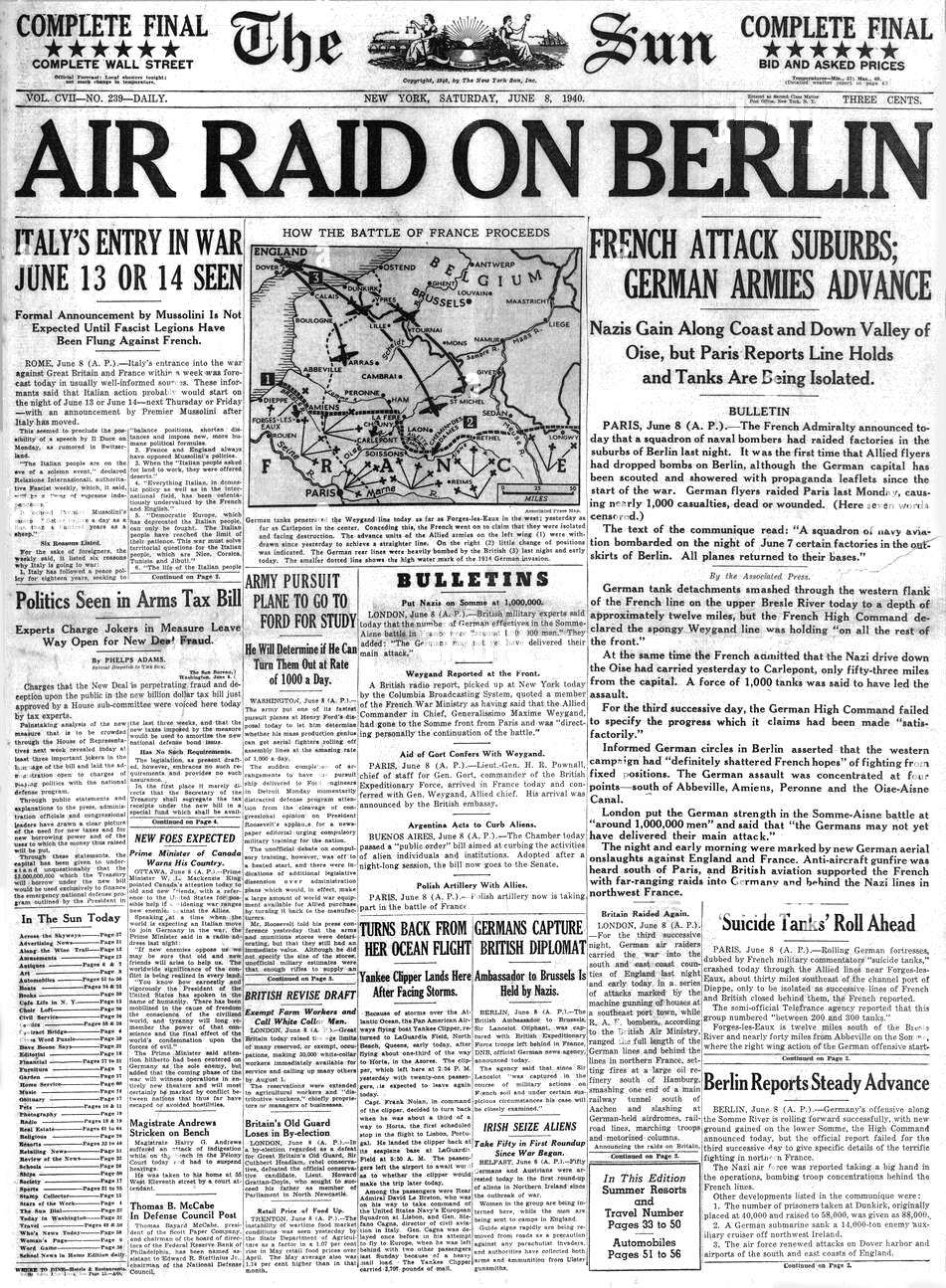
Finally on the night of June 6/7, 1940, a week before The Fall Of Paris, the French Navy went into the offensive attacking Berlin on a night raid. It was made just by one plane, and no other raids will be made again by French forces during the rest of the war. Damage to the capital was slight but it was a truly pioneer.
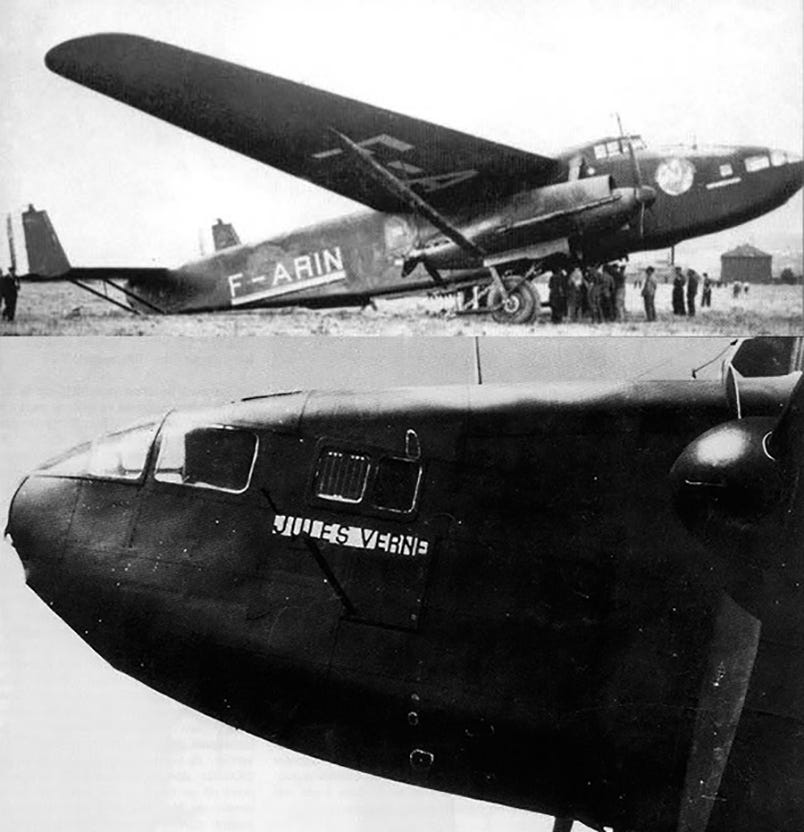
The only long-range bomber available in 1940 was the Farman F.220, a rather ungainly four-engine aircraft dating back to the mid-1930s based on the French idea of the ‘multiplace de combat’, an outdated concept of air war. The Aéronautique Navale was in possession of three Farman 223.4, former postal aircraft that had been requisitioned by the Navy and given the names Camille Flammarion, Le Verrier, and Jules Verne. The ‘Jules Verne’, formerly Air France’s F-ARIN, was assigned to Capitaine de Corvette Henri Daillière in April 1940.
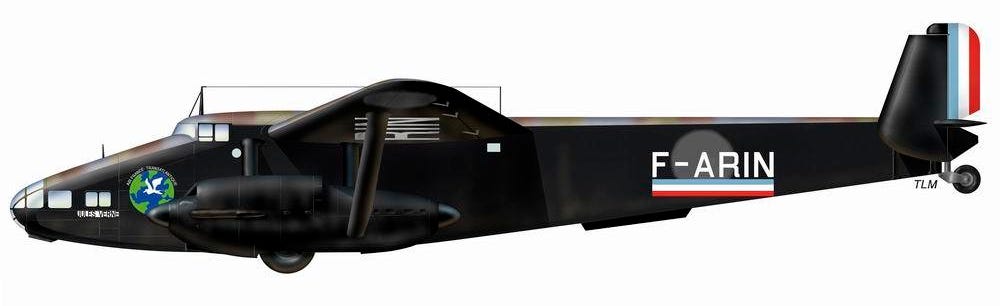
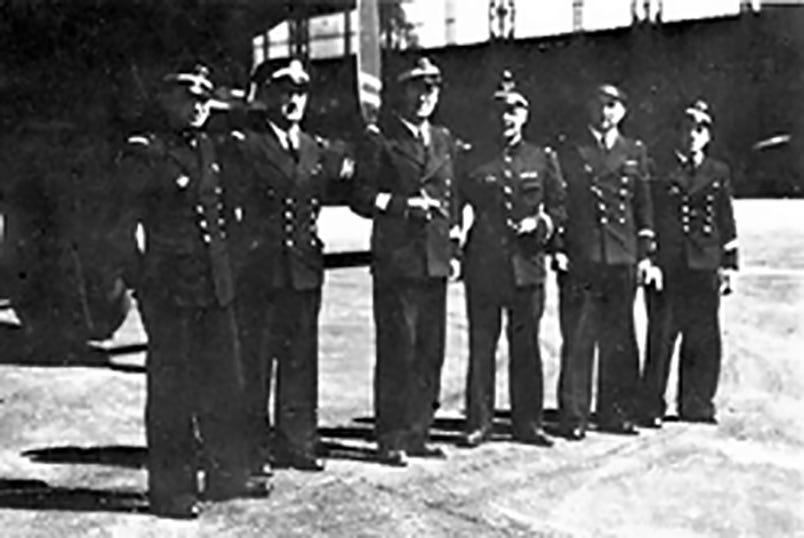
The experienced crew of the Jules Verne: C.C. Daillière (commandant, at centre); l’Enseigne de Vaisseau Comet (navigator); Maître Principal Yonnet (pilot); Maître Corneillet (flight engineer); Maître Scour (radioperator) and Second Maître Deschamps (mitrailleur-bombardier).
The first raid
Daillière was given the mission to be the first aviator to attack the Reich capital with ordnance. The ‘Jules’ took off from Merignac airfield near Bordeaux at mid afternoon and set course for Berlin. The crew proceeded over the North Sea at dark, later flying in over the Baltic Sea before turning south and heading straight for Berlin at high altitude. Daillière says: ‘I got ready to release the bombs and realized that someone had failed to install our bombsight, so I pressed my nose to the glass of the cockpit’. He wasn’t able to identify natural landmarks, and Berlin was blacked out; but once the city’s searchlights came on, the city was defined. He tried to create the impression of more than one airplane, and dropped bomb load over some factories in Berlin’s north end, where some bombs fell in the administrative district of Pankow (Demps, 2015). They claimed to have dropped eight bombs of 75 kg and 80 small-size incendiaries at low level (and even one boot, thrown by Corneillet as an insult to Hitler).
Daillière made for Paris in a straighter path back to France, and landed at Orly Airfield. They met no resistance on the return leg, and when the aircraft touched down, it had covered nearly 3,000 miles in 13.5 hours on this epic mission. The French Admiralty released a communique on the next day stating that ‘a squadron of navy aviation bombarded had raided factories in the outskirts of Berlin last night’ highlighting the action, the great distance of the target and that all planes (sic) had returned safely to their base. On the night of 10/11, the same crew raided the Heinkel plant at Rostock, using the same tactics and return route.
Hitler -and Berliners too- knew after the French attack that they’re vulnerable at their own home.
A forgotten raid?
Curiously, this raid was mentioned in the French war reports only, the city’s air alarm list recorded during the war doesn’t show any alarm registered on that night (or in the previous one), so the big question here is: Did the Germans not notice the Farman’s air-attack, or did Nazi authorities cover it up? Most probably the latter one.
Widely promoted by French postwar authors, on the contrary German historians have mostly obliterated this early bombing action -as well as by British historians and aviation authors, even on recent published works, (Overy, etc) which most of them still referring to the RAF’s August 26, 1940, raid as the “first bombing of Berlin”. As Rayner Ehm reflects, for German authors, neither the French bombing doctrine nor the French strategic air war in May/June 1940 appears to have been a central theme at any time. Rudolf Dörrier was the first to refer to this action in his focused study of the Pankow district (1971) and more recently Girbig (which even dedicates a brief chapter to it, 2001) and Demps (2015) show some text lines to the raid on their respective Berlin’s air raids works also, but this very first raid still lays out of the radar to the main public.
Sources and Bibliography:
Ammac du Fumelois. Quand les marins bombardaient Berlin. 2010. (accessed February 2026)
Comet, Paul. ‘Sur Berlin avec Daillière’, Icare, no. 61 (1972), 92-101
Demps, Laurenz (Ed). Luftangriffe auf Berlin. Die Berichte der Hauptluftschutzstelle. Ch. Links Verlag, 2014
Dörrier, Rudolf. Pankow. Chronik eines Berliner Stadtbezirkes. Hrsg. vom Rat des Stadtbezirks Berlin-Pankow, 1971
Fernandez, José & Laureau, Patrick. French Bombers of WWII (White Series). Mushroom Model Publications, 2019
Giebel, Wieland. Bomben auf Berlin: Zeitzeugen berichten vom Luftkrieg. Berlin Story Verlag, 2015
Girbig, Werner. Im Anflug auf die Reichshauptstadt: die Dokumentation der Bombenangriffe auf Berlin. Motorbuch-Verlag, 2001
Overy, Richard. The Bombing War: Europe, 1939-1945. Allen Lane, 2013
Shirer, William (1941). Rise And Fall Of The Third Reich: A History of Nazi Germany. Simon and Schuster, 1990
Sweeting, C.G. Target Berlin: The First Air-Raid on the German Capital. HistoryNet. 23 January 2017 (accessed February 2026)
Thank you for reading Berlin Bombenkrieg by Pablo López Ruiz. Please subscribe, if you haven’t yet, to comment, follow and share. All images used for non profit / educational purposes.
The raid was targeted to hit nine French aerodromes and several factories located around Paris at Villacoublay and Les Mureaux, killing 254 people, 195 of them civilians. (Overy 2013, p 66). On June 11th, following the German raid, French commander-in-chief declared Paris an ‘open city’, escaping the same fate suffered by Warsaw or Rotterdam previously.